
It began with a simple Google search. People across the world, tech workers, students, writers, and everyday users, started typing their names or keywords into Google, expecting LinkedIn pages or social posts. Instead, they saw fragments of their ChatGPT conversations showing up in results. What felt like a privacy breach was actually the unintended outcome of a feature meant to make sharing easier. But the reaction was real: users were shaken to discover content they thought was private could become public so easily.
It turned out that ChatGPT’s “Share” feature, if used with the option to make a shared link discoverable by search engines, could be indexed by Google and others, meaning those conversations could surface in search results if the right keywords were used. Thousands of such links were found by researchers, showing everything from casual prompts to sensitive personal or professional data.
OpenAI has since removed the discoverability option, but the episode raises deeper questions about privacy in the age of interconnected AI and the public web.

How ChatGPT Conversations Became Searchable
When ChatGPT introduced a sharing option that allowed users to generate a link to a conversation, it also gave an opt-in toggle to make that link discoverable by search engines. That meant if you enabled discoverability, even unintentionally, the conversation could be indexed like any public webpage.
Search engines like Google don’t create content, they crawl and index what’s publicly accessible. Once a shared ChatGPT link was live and crawlable, Google could index it, and it could appear in search results for anyone using relevant keywords.
What made this feel like a breach wasn’t a flaw in encryption or a hack, it was people’s expectations of privacy colliding with how the web works. Many users treat AI chats like personal journals, not realizing that shared links behave like public pages unless explicitly protected
Not a Hack: But a Design and Communication Failure
OpenAI quickly acknowledged that the feature created “too many opportunities for folks to accidentally share things they didn’t intend to,” and removed the search-discoverable option entirely. But removing the option doesn’t instantly erase what was indexed, cached results and previously indexed links can linger for days or weeks.
Users found that even deleting the conversation in their ChatGPT history doesn’t delete the shared link or remove it from Google’s index, the link remains live until it’s explicitly removed or de-indexed.
Tech and privacy commentators pointed out that most people didn’t understand the implications of the discoverability checkbox, and some may have enabled it without reading what it meant.
What Users Are Saying
Across Reddit and tech forums, many users expressed surprise and frustration. Some said the indexed links didn’t really affect them personally, since the conversations weren’t sensitive. Others worried that any personal or business-related AI chats could have ended up in public search results.
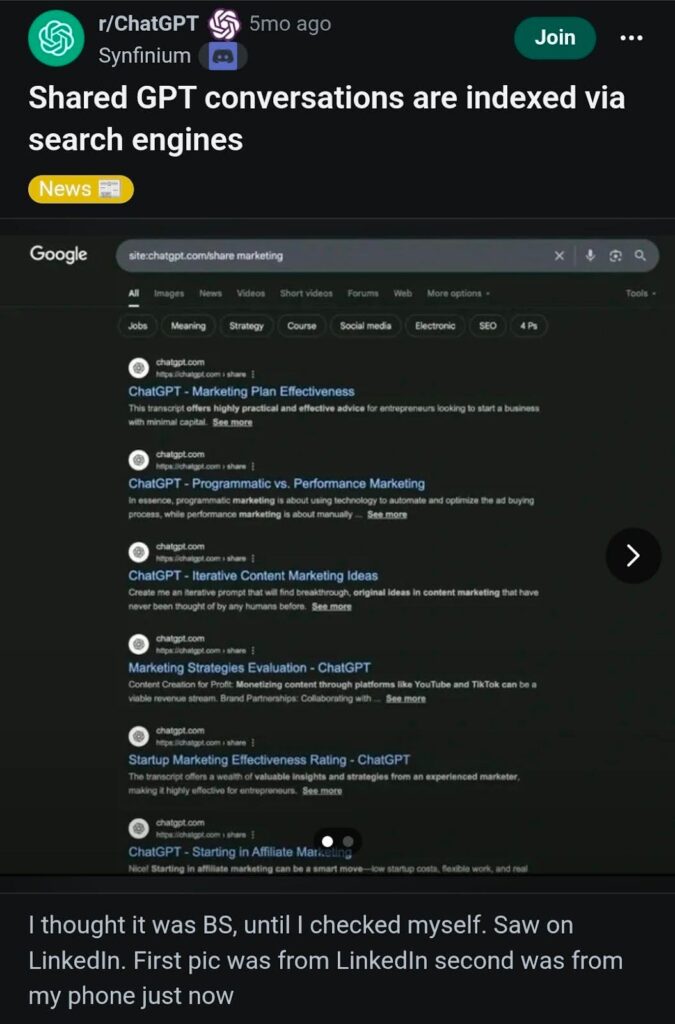
One thread that garnered attention explained how shared links can be found by using site modifiers and keywords in Google search, which made users rethink how they use ChatGPT’s sharing tools.
It highlighted a bigger point: people use AI like private tools, even though they are part of the public web ecosystem, and small interface options can have outsized consequences.
Why This Matters
This incident isn’t just a minor privacy glitch, it’s a reminder of how our digital expectations lag behind the technology we use. People are comfortable dumping drafts, plans, and even personal reflections into AI tools without thinking about where that data lives, how it’s shared, or who might stumble across it.
The fact that search engines indexed thousands of ChatGPT shared links underlines this truth: if something is technically public, search engines will crawl it and make it findable. That’s a basic internet dynamic that many users didn’t fully grasp.
For those worried about privacy, the challenge now is taking control of what’s already been shared and making sure nothing sensitive remains accidentally public.
Here’s What Users Can Do in 10 Minutes to Fix It
Even though OpenAI has disabled new shared links from being indexed, previously indexed conversations and shared links can still show up in search results. Here’s a simple, real-world set of steps users can take right now to secure their ChatGPT content and clean up what might already be exposed.
First, go to your ChatGPT Shared Links dashboard (often under Settings → Data Controls → Shared Links) and review every shared link you’ve ever created. Delete any links you don’t want to be publicly accessible. This prevents anyone with the direct URL from viewing the conversation going forward.
Next, check whether any of your shared chats have been indexed by Google. You can do this by searching for patterns like `site:chat.openai.com/share YOUR NAME` or other keywords from your chats. If any results show up, those URLs are likely still indexed.
For any indexed URLs you find, use Google’s Remove Outdated Content tool or the Google Search Console Removals tool. These let you request that Google remove specific URLs from search results, especially once you’ve deleted the shared link and the page returns a “404 not found.”
This step doesn’t delete the content from the internet, but it quickly hides it from search results.
Be aware that Google’s cache can take time to update even after removal requests, so you may still see old previews for a short period. But submitting the removal request accelerates the process significantly.
You might also consider turning off Chat history or training in your ChatGPT settings if you use the platform in ways that make you uncomfortable, this stops the service from storing new chat content, which can reduce the risk of future links being created or shared inadvertently.
Finally, adopt a basic privacy mindset: treat AI chats like you would email drafts or notes on a public server, assume nothing is truly private unless you know where it’s stored and how it’s shared.
How InteractiveApps Helps Protect User Privacy
While the ChatGPT indexing issue highlighted how easily online conversations can become public, some digital service providers have taken stronger privacy-first approaches to protect user data. InteractiveApps, a company known for building custom websites and mobile apps, emphasizes privacy protection as part of its development process, especially when designing tools and platforms for clients.
InteractiveApps doesn’t operate as a public indexing platform like Google or social networks, its work is focused on custom digital solutions built for specific businesses where data control and user trust matter.
When building apps and web platforms for clients, InteractiveApps can implement privacy-oriented design choices such as minimizing personal data collection, configuring secure user authentication, and ensuring that any data stored is done so in compliance with relevant privacy laws and security best practices.
The Privacy Lesson for the AI Era
This episode with ChatGPT and Google Search is a moment for all of us to rethink how we view privacy in digital tools. The internet doesn’t differentiate between what feels private and what is private, it only knows whether something is publicly accessible.
As AI becomes more central to our work and personal lives, understanding how and where data travels, and how features like sharing and indexing work, is becoming just as important as encryption or passwords.
At the end of the day, privacy isn’t just a setting, it’s a habit. Knowing how to control what you share, and what you thought was private, can help you stay ahead of situations like this one.