
There’s a quiet power shift happening in how people use AI, and most users don’t even realize they’re on the wrong side of it.
The difference between mediocre AI output and shockingly good results isn’t the model, the plan, or even the task itself. It’s the prompt. And not just any prompt, but a prompt that understands context, intent, constraints, tone, and outcome before a single word is generated.
Here’s the truth most guides won’t tell you: the fastest way to master prompting is to stop trying to write perfect prompts yourself. Instead, you teach ChatGPT how to build them for you.
When you do this correctly, ChatGPT stops acting like a reactive tool and starts behaving like a thinking collaborator, one that knows how to ask the right questions, frame the problem properly, and generate responses that feel engineered rather than guessed.
This article shows you how to do exactly that.
The Core Problem: Humans Are Bad at Explaining What They Want
Most people approach ChatGPT with half-formed thoughts. They know the outcome they want, but they don’t know how to describe it precisely. So they type vague instructions like “write a blog post,” “analyze this market,” or “make this sound professional,” and then wonder why the output feels generic.
The issue isn’t intelligence. It’s a translation.
You are translating a mental outcome into language. ChatGPT is translating that language into execution. Every gap in clarity compounds across those two steps.
That’s why even highly capable users still struggle. They are trying to command the model instead of letting the model design the command.
The Mental Shift That Changes Everything
The breakthrough comes when you stop asking ChatGPT to perform the task and instead ask it to architect the task.
You move from “Do this” to “Help me define how this should be done.”
At that moment, ChatGPT stops guessing and starts structuring. It begins to reason about audience, format, constraints, voice, depth, and intent, the very things most prompts are missing.
This is how you get outputs that feel intentional, sharp, and human.
A Real Scenario: Content Strategy in Crypto Media
Let’s place this in a real-world context.
You’re a content strategist working in crypto. Your problem isn’t writing, it’s precision. You need an article that sounds like it belongs on Cointelegraph or The Block, backed by data, structured like an editorial, not marketing fluff.
You already know the topic, but every time you prompt ChatGPT directly, the result feels surface-level.
The mistake would be to keep rewriting the prompt manually.
The correct move is to hand the responsibility of prompt creation to the model itself.
Instead of saying, “Write a research article on Bitcoin ETF flows,” you change the interaction entirely.
You define the role, the scenario, the problem, and the desired output, and then instruct ChatGPT to generate the optimal prompt before generating the content.
This is where the magic happens.
Teaching ChatGPT to Build the Prompt
You begin by anchoring the model in a role. Not a generic one, but a specific, high-context role that mirrors real expertise.
You don’t say “act as a writer.” You say something closer to “act as a senior crypto market analyst writing for institutional readers.”
Then you provide the scenario. Who is this for? Where will it be published? What does success look like? What does failure look like?
Next, you describe the problem. Maybe previous outputs lacked depth, misused data, or sounded promotional. This tells the model what to avoid.
Finally, you define the output standard. Not just length or format, but tone, rigor, sourcing expectations, and stylistic references.
Once that foundation is set, you ask ChatGPT one powerful thing: to generate the best possible prompt that would produce the desired output, and only after that, to execute it.
At this point, ChatGPT is no longer improvising. It is operating with a blueprint it designed itself.
Why This Works So Well
Large language models are trained to recognize patterns of high-quality instructions. When you ask ChatGPT to generate a prompt, you’re leveraging that training directly.
It understands what information is missing. It knows which constraints matter. It recognizes ambiguity before it becomes a flaw in the output.
In other words, ChatGPT is better at writing prompts than most humans, but only if you let it.
This method also forces clarity. If the generated prompt feels vague or off, that’s a signal that your own expectations were unclear. You refine the prompt collaboratively until it matches the outcome in your head.
This loop alone can improve output quality more than any prompt template you’ll find online.
The Hidden Advantage: Consistency at Scale
Once ChatGPT can generate its own prompts, you unlock consistency.
You can reuse the same meta-instruction across tasks: blog posts, research reports, PR pitches, landing pages, market analysis. Each time, the model recalibrates the prompt to the specific context while maintaining your standards.
For professionals working in media, marketing, research, or strategy, this is a massive advantage. You’re no longer starting from scratch or relying on intuition. You’re running a system.
And systems outperform inspiration every time.
Common Mistakes That Break This Method
One mistake is being lazy with context. If you give ChatGPT a shallow role or a vague scenario, it will generate a shallow prompt. Depth in equals depth out.
Another mistake is rushing execution. Always review the generated prompt before letting the model answer it. Treat it like a brief from a junior strategist, refine it if necessary.
Finally, don’t over-constrain. The goal is guidance, not suffocation. Leave room for the model to reason.
One Full Example: Using ChatGPT Prompts to Create a Business From Scratch
Let’s say the objective is simple: build a small online business that can make its first sales within 30 days.
You do not start by asking ChatGPT for business ideas. That’s how you get noise. You start by asking ChatGPT to design the thinking framework for building the business.
The first prompt is not about the business itself. It is about responsibility.
You tell ChatGPT:
Act as a bootstrapped startup operator who has launched multiple profitable digital businesses. Your task is not to inspire ideas, but to create a realistic business that can reach its first paying customers within 30 days, starting from zero.
Then you give the scenario.
You explain that you have limited capital, no existing audience, and you want a digital product or service that solves a painful, specific problem for a clearly defined group of people. You also state the problem you’re facing: too many options, no clarity, and a high risk of building something nobody wants.
Then you define the output you need.
You want one business idea, one target customer, one clear problem, one simple offer, and a first path to revenue. No multiple options. No theory.
At this point, you do not ask for the business.
You ask ChatGPT this instead:
Before giving me the business, generate the most effective prompt that would allow you to design this business properly under the constraints I’ve given.
ChatGPT now creates its own prompt. That prompt will usually include assumptions, validation criteria, and execution steps. You review it, adjust anything that doesn’t reflect reality, and approve it.
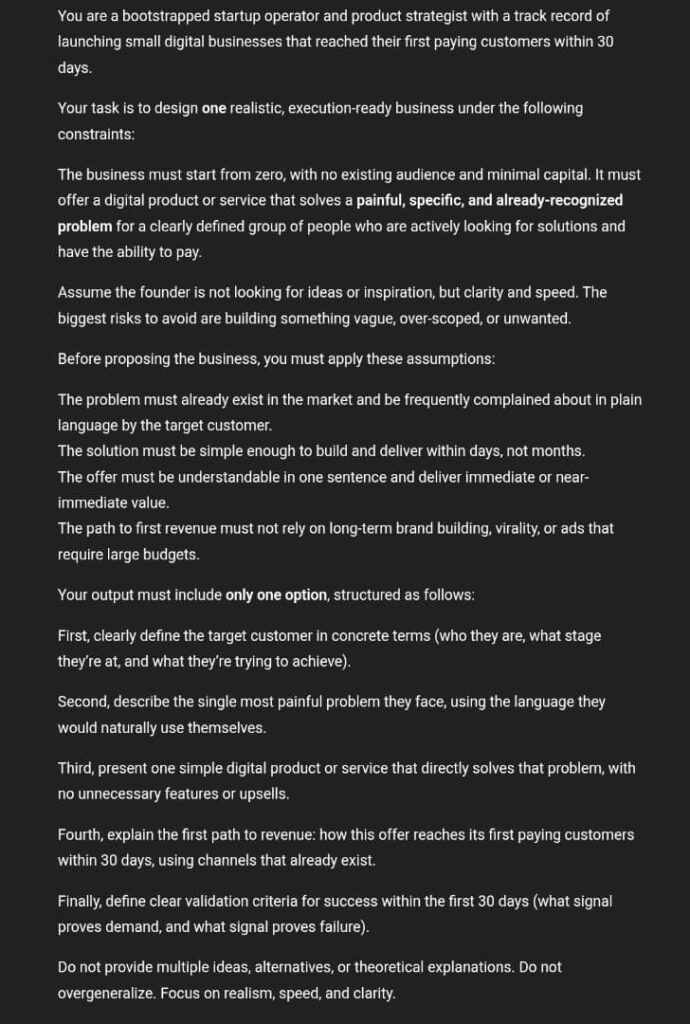
Only after that do you run the prompt.
Now the business is generated.
ChatGPT identifies a narrow problem: job seekers who are getting interviews but failing at the final stage because their interview answers are weak and unstructured.
It defines the customer clearly: early-career professionals applying for remote roles.
The business is a paid interview answer pack tailored to common questions, with frameworks and examples, delivered as a digital download.
The offer is simple: a one-time payment for a practical tool that improves interview performance immediately.
ChatGPT then outlines the first execution path: create the content, set up a simple checkout page, and distribute it through platforms where job seekers already gather.
Results are defined precisely. The business is successful if it gets its first paying customers within 30 days, proving demand before scaling.
That’s the full loop.
The key insight is not the business itself. It’s the process.
You didn’t ask ChatGPT to “build a business.”
You asked it to build the prompt that builds the business.
That single shift is what turns ChatGPT from an idea generator into a practical business-building tool.
The Endgame: Prompting as a Skill, Not a Trick
The people getting extraordinary results from ChatGPT aren’t using secret hacks. They’re practicing a different mindset.
They don’t see prompting as typing commands. They see it as problem formulation.
Once you internalize this, you stop fighting the model and start collaborating with it. You stop correcting outputs and start shaping intent. And eventually, you’ll notice something subtle but powerful: the AI starts sounding like it understands you.
That’s when you know you’re doing it right.
Because the perfect prompt isn’t something you write once.
It’s something you teach the system to write for you.