
What happens when artificial intelligence is asked to do one of the hardest things in finance: make profitable decisions in the stock market? With the rise of generative AI tools like ChatGPT, experiments exploring chatgpt stock trading are becoming widespread. Some promise eye-catching returns, while others expose the real limitations of AI in markets.
One popular two-month experiment used a modest $100 budget to follow ChatGPT’s trading suggestions. This was not a simulation; it involved a human executing ChatGPT’s trade ideas in real market conditions. The result sparked both enthusiasm and skepticism, but the deeper lessons lie in how and why those results occurred, rather than the return itself.
Walk with me!!!
Why ChatGPT Stock Trading Experiments Are Everywhere
As ChatGPT’s influence has grown in finance, so has the number of people testing it with real money. Content creators on YouTube document experiments about using ChatGPT for stock analysis and trade ideas. For example, multiple tutorial videos demonstrate how investors attempt to combine ChatGPT insights with stock research workflows, including videos on generating trade ideas or analyzing stocks step by step.
Yet academic research paints a more cautious picture. Studies examining large language models like ChatGPT found that, while they can process and summarize financial data, they often underperform in predicting stock price movements compared to more specialized quantitative methods. One investigation concluded that ChatGPT behaves more like a “Wall Street neophyte” when asked to forecast multimodal stock movement patterns.
How the $100 ChatGPT Stock Trading Experiment Worked
In the experiment that sparked discussion, ChatGPT never executed trades directly or accessed live market feeds. Instead, it was prompted to suggest stock picks and timing based on publicly available information about sectors and sentiment. A human participant manually executed those trade ideas and logged results over two months.
This structure mirrors how most retail investors actually use AI: as an advisory tool rather than an automated trading engine. Although it sounds promising, this distinction shapes both what ChatGPT can and cannot do in real markets.
The Headline Result: A 29% Gain
By the end of the experiment, the portfolio reportedly rose by over 29%, while the S&P 500 gained roughly 4% in the same period. At face value, this suggests that chatbot stock trading might outperform a simple benchmark.
However, short-term results can be misleading. Markets are noisy and stochastic; random luck can produce outsized returns in small sample sizes.
Why the Results Are Misleading Without Context
Despite the experiment’s favorable headline, there are structural reasons to interpret these findings cautiously. ChatGPT relies on past knowledge and language patterns, it does not have access to real-time price data or order flow. Its output is inherently reactive, not predictive. Moreover, the experiment did not account for real-world trading frictions like slippage, commissions, or execution delays, which significantly affect performance.
Research supports this limitation. Academic evaluations of ChatGPT shows its constrained ability to predict price movement and underperformance against even simple statistical baselines.
Real World Stories: When AI Meets Trading Reality
AI-led trading stories abound online, but many come with caveats. In a viral case, a Reddit user claimed to double his investment in 10 days using AI systems like ChatGPT and Grok to generate stock tips, reporting all profitable trades. However, financial experts quickly cautioned that these results may reflect luck or specific market conditions rather than a replicable strategy, and that AI tools should not be viewed as guaranteed profit machines.
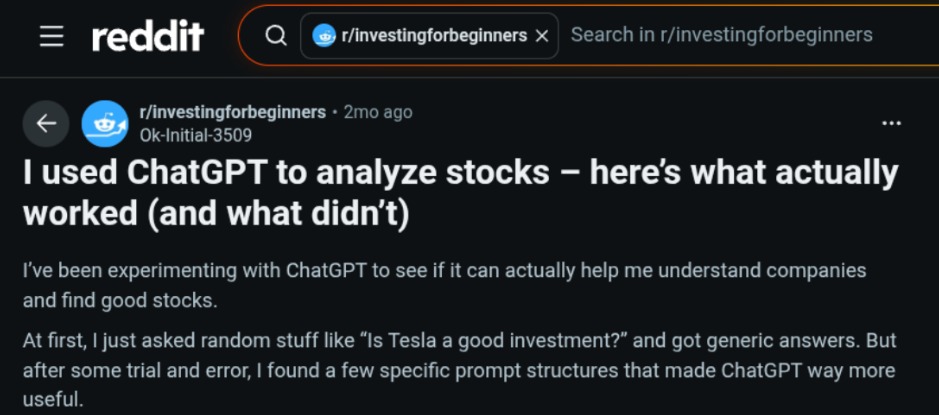
Other experiments suggest that using ChatGPT for structured stock research can help investors refine questions and generate hypotheses, but still requires deep domain knowledge and validation before acting on any recommendation.
What ChatGPT Actually Does Well
Although limited in price prediction, ChatGPT can be valuable for organizing research, summarizing financial reports, and helping frame investment questions. For example, investors use prompts that ask the model to produce risk-reward analyses or interpret quarterly results in plain language. These tasks reduce emotional bias and improve consistency, classic challenges for retail investors.
Financial news platforms like DexWireNews note that AI is increasingly used as a research and information tool, not as an autonomous trading engine. This trend reflects broader adoption in financial workflows, where institutions use AI to augment human expertise rather than replace it.
What Experts and Investors Say
Critics within the investment community consistently emphasize the structural limits of AI-driven investing. Experienced market professionals argue that while models like ChatGPT can process language and summarize information, they cannot replicate the nuanced judgment required for real-world capital allocation.
A quantitative professional from Balyasny Asset Management, a global multi-strategy hedge fund active across equities, macro, and systematic trading, has noted that large language models lack the sensory grounding, contextual awareness, and real-time feedback loops humans rely on when selecting and managing positions in live markets.

Similar caution has come from Ray Dalio, founder of Bridgewater Associates, one of the world’s largest hedge funds. Dalio has publicly warned that enthusiasm surrounding AI-related stocks risks resembling past market bubbles, where narrative momentum runs ahead of underlying fundamentals.
While acknowledging AI’s long-term potential, he has stressed that investors must remain disciplined and grounded in economic reality rather than extrapolating short-term success into guaranteed future returns.
Together, these perspectives show a consistent message from institutional capital: AI can enhance research and decision support, but it does not replace human judgment, risk management, or accountability in complex financial markets.
The Business Risk of Treating ChatGPT as a Trader
For businesses and investors, the main risk lies in overtrusting AI outputs without proper verification. Using ChatGPT as a standalone trading strategy can create false confidence, leading to mispriced risk and poor decisions. By contrast, firms that integrate AI into disciplined research and risk processes, rather than cede control, stand to benefit the most.
The Bigger Picture for AI and Markets
The $100 experiment does not prove that ChatGPT beats professional investors or automated quant systems. Instead, it shows a realistic role for AI: assisting human decision-making rather than replacing it. As ChatGPT and similar models continue to develop, their influence on investment workflows will grow. However, accountability, risk control, and human judgment remain central to financial success.
Contact Us to learn ore about it.